
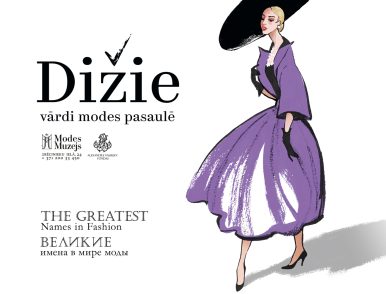
The Greatest Names in Fashion (TICKETS FOR GUIDED TOUR)
At the heart of fashion lies a constant quest for the new and for change – yet in the history of fashion there are names to which we return time and again: with admiration and respect, to draw inspiration or to rediscover them.
These names are inscribed in the history of fashion in letters of gold – fashion designers, or couturiers, who have brought about changes in fashion, offering a vision so compelling and original that it has been accepted without reservation, or who have been particularly skilful in drawing on traditions, craftsmanship and timeless beauty. Some of these names are known to everyone, even those who claim to have no interest in fashion, whilst others have been quite undeservedly forgotten – largely because the fashion houses founded by these masters no longer exist. The transient nature of fashion is ruthless in this respect…
The exhibition ‘The Greatest Names in Fashion’ offers an insight into the history of 20th-century fashion by tracing the journeys of its creators: from Paul Poiret’s oriental extravagance to Gabrielle ‘Coco’ Chanel’s modern approach, from the refined femininity of Jeanne Lanvin and Madeleine Vionnet to Elsa Schiaparelli’s bold surrealism, from Christian Dior’s ‘flower-woman’ to Cristóbal Balenciaga’s sculptural mastery, from the 1960s minimalism of Hubert de Givenchy, Pierre Cardin and André Courrèges to the flamboyant Italians Valentino Garavani and Gianni Versace, concluding with the provocative trends in Parisian haute couture introduced by Jean-Paul Gaultier and John Galliano.
The exhibition will also provide an insight into the significant periods of change that fashion – and haute couture in particular – has undergone. In its day, haute couture consisted of made-to-measure garments of the very highest quality, crafted from the finest materials.
The luxury of these garments lay not in their bright colours or extravagant silhouettes, but in their impeccable cut, tailoring and the quality of the fabrics. Today, one would call this ‘quiet luxury’ – silk cocktail dresses, day suits, woollen coats. However, the craftsmanship is of such high quality that each of these garments is a true little masterpiece, which fashion connoisseurs will recognise at a glance.
In the 1950s, the idea that designer clothes could also be sold in shops as ready-to-wear items – choose your size, pay and put them on! – began to attract increasing attention. Prêt-à-porter clothing enabled fashion houses to reach a much wider clientele, as the prices of such garments were significantly lower and they were more readily available – without the need for measurements or repeated fittings. In the 1960s, this new approach became firmly established in the fashion industry – haute couture now had to compete with garments that were more affordable but no less interesting in terms of design.
Nowadays, there are very few fashion houses left that adhere to the strict rules of haute couture, and their client base is also shrinking. Not everyone can afford an outfit costing anywhere from several thousand to as much as hundreds of thousands… As lifestyles change, there are no longer as many occasions where one might wear such special outfits.
For the most part, fashion houses make their money from ready-to-wear clothing, as well as collections of cosmetics, perfumes and accessories. Haute couture, on the other hand – for those fashion houses that have retained this division at all – serves more as a huge, visually spectacular show. Its purpose is not so much to offer designs that can actually be worn, but rather to build the fashion house’s reputation and recognition, define its stylistic direction and showcase its creativity.
Fashion, as it has always done, accurately reflects what is happening in society: convenience and comfort are becoming more important to us than high status and a flawless cut, which require us to maintain a straight posture, strike elegant poses to complement our outfits, and choose equally flawless accessories. Does this mean that the unique craftsmanship of couturiers, tailors, seamstresses and embroiderers will be lost? – As long as the ateliers of fashion houses, much like secret treasure troves, preserve the priceless skills and experience that master craftsmen have passed down from generation to generation, we need not worry about fashion.
Tickets
guided tour 30€
individual admission 8€
groups 7€
pupils, students and seniors 5€
children under 5 years – free admission